
Buncombe's City Directory Shelf
Asheville is the core directory shelf for Buncombe County. Pack Special Collections says its Asheville City Directories run from 1883 to the present and hold name, street, and business listings. The earliest volume also has a Buncombe County gazetteer and rural post-office or residence references, so it can reach beyond a narrow downtown search. Later volumes are more focused on Asheville. Start by recording the exact year and volume, because a shelf run and an online run are not the same thing.
| Collection | Years | Where held | Access |
|---|---|---|---|
| Asheville City Directory and Gazetteer | 1883–84 | UNC North Carolina Collection through DigitalNC | Free scan |
| Asheville City Directories | 1883–present | Pack Special Collections, lower level | Printed name, street, and business listings |
| Miller's Asheville City Directory | 1937–39, 1950, 1954, 1956–58 located | DigitalNC | Volume-specific scans and text |
| Hill's Asheville City Directory | 1960–62 located | DigitalNC | Digitized individual volumes |
| Asheville Times and Asheville Citizen | Microfilm; Citizen 1885–1926 online | Pack and DigitalNC | Notices, obituaries, and address context |
The free material is useful but incomplete. DigitalNC returned 57 Buncombe or Asheville directory records during research, including selected Miller's and Hill's volumes. It does not establish that every year is online. For a missing year, use Pack's print collection, ask about Archive.org links supplied through Pack resources, or consult another named repository rather than filling the gap with an assumption.
Buncombe Directory Shelf at Pack
Pack Special Collections is in the lower level of Pack Memorial Library at 67 Haywood Street in Asheville. The room is open to anyone. Its posted hours are Tuesday 9 a.m. to 7 p.m. and Wednesday through Friday 9 a.m. to 5 p.m.; older guidance lists different Saturday information, so call 828-250-4740 before a trip. The collection also supplies local newspapers on microfiche, maps, oral histories, photographs, historical-building material, and a house-history guide.
At the desk, bring the street spelling, likely years, and any prior house number. The street index can show when a number appears, while the name index often carries an occupation and spouse notation. Staff can direct a reader to the right volume or related collection, but a precise question is still more useful than a request to reconstruct an unknown household.
Note: Pack's current web hours and older house-history guidance differ, so confirm access details before relying on a Saturday visit.
Digitized Buncombe Directory Runs
DigitalNC's Buncombe directory results are the fastest way to identify which volumes have a scan. The collection includes the 1883–84 directory, Miller's volumes for 1937, 1938, 1939, 1950, 1954, and 1956 through 1958, plus Hill's volumes for 1960 through 1962. Each listing needs its own check for publisher, year, and access. A scan may have searchable text, a PDF view, or only image pages.
The 1883–84 volume is particularly broad. Its introduction describes it as the first directory of its kind for Western North Carolina, and its county gazetteer can give a rural reference that later city-focused books may not. The introduction also warns that many streets were unnamed and some people could not be assigned an exact location. That limitation belongs in the search notes, not in a conclusion about whether a person lived in Buncombe.
Use the exact cited volume when comparing years. The 1883–84 Asheville directory scan shows the kind of digitized original available through this route.
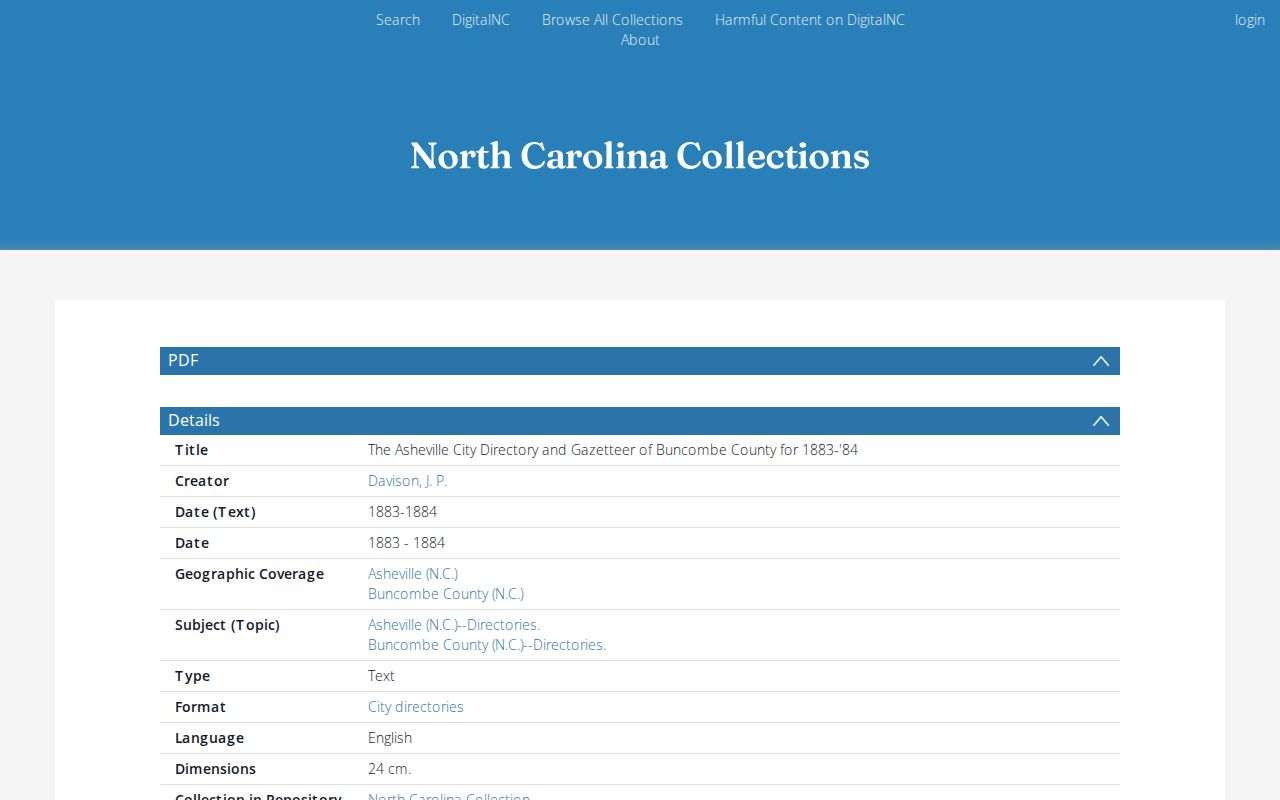
The scan supports close reading of the original volume, including its introductory cautions and the county-gazetteer setting that can disappear in a simple name search.
Note: DigitalNC results identify scanned volumes, but a missing result does not establish that the year was never published or held locally.
Buncombe City Directory Entry Clues
Each entry needs to be read as a compact record, not as a modern profile. In the inspected 1937 Miller's Asheville volume, entries can show surname and given name, spouse in parentheses, widow notation, occupation, business connection, house number, street, and a residence or householder mark. The same book may use a continuation such as “do” for the address already stated. Read the front abbreviation pages for that particular volume before turning a mark into a family fact.
| Name | Identifies the listed person; initials and spelling can vary by year. |
|---|---|
| Spouse or widow note | Parentheses may name a spouse; “wid” identifies a widow in the directory's terminology. |
| Occupation and connection | May name a trade, business, or employer, which is a historical lead rather than proof of residence. |
| Number and street | Places the entry at a stated address for that directory year. |
| Residence mark | The 1937 key defines “r” as roomer or resides and “h” as householder. |
- Criss-cross directory
- An address-to-occupant arrangement. Pack confirms this use, though the exact local title and full run were not located.
- Householder index
- A name arrangement centered on the household head or listed resident, depending on the volume.
- Abbreviation key
- The publisher's explanation of its short forms, usually found in introductory pages and necessary for sound interpretation.
The 1937 sample also contains a period race notation. Preserve it only when quoting or transcribing a historical source, explain its context, and do not treat it as current terminology.
Buncombe Address Number Changes
Early Asheville address work has a local trap. Pack's house-history guide says numbers changed as new houses were built, especially before 1930. A current number may therefore fail in an older volume even when the building is the same one. The 1883–84 directory adds a second problem: some streets were unnamed and some residents could not be assigned an exact location.
Test the street without a number, inspect nearby listed occupants, and compare landmarks or the legal description from a deed. Sanborn maps, the 1891 and 1912 panoramic maps, tax cards, and a deed or plat can help hold the place steady while street numbers shift. A missing exact number is a reason to widen the search, not evidence of an empty lot or absent household.
Trace a Buncombe City Directory Household
For family history, follow the same person and address across directory years, then use census releases and local sources to test the pattern. Federal census years from 1790 through 1950 are public under the 72-year release rule as of 2026. Directories just before and after a census can help bridge a move, a household change, or a renumbered street. They do not replace a census or prove title.
- Find the earliest likely name or street appearance and note the full entry, page, year, and publisher.
- Check adjacent directory years for the same name, spouse notation, occupation, and address change.
- Search the street index or verified address arrangement for nearby occupants and number patterns.
- Pair the sequence with the nearest public census and compare household relationships rather than assuming a match.
- Use a deed chain for ownership, then check newspapers, obituary indexes, cemetery material, or probate when the name disappears.
A disappearance can reflect a move, death, changed surname, different listing practice, or simple omission. Pack's obituary route uses death indexes and Register of Deeds death records to locate relevant Asheville Times or Asheville Citizen material. For a present-day address chain, the Buncombe street directory covers the current property route.
Buncombe Directory Newspaper Clues
Directories establish a date-stamped association. Newspapers can add the event that explains it. DigitalNC lists 11,621 issues of the Asheville Citizen from 1885 through 1926, while Pack maintains local newspaper microfiche and on-site research resources. Search a name and street around the gap between two directory years for purchase notices, construction, social announcements, weddings, deaths, or a business move.
Use the result as a lead, then compare it with the directory and a primary county record. A construction notice dates reported work, not necessarily an ownership transfer. An obituary may point to relatives or a cemetery record, but it is not a replacement for a probate file where one exists.
Buncombe Directory Research Rooms
When Pack's shelves do not answer a question, use the repository that fits the missing evidence. The Old Buncombe County Genealogical Society at 128 Bingham Road, Suite 950, has more than 10,000 volumes, microfilm, a FamilySearch Affiliate Library designation, obituary copies, and a Buncombe divorce index. Its volunteer docent hours are Tuesday through Saturday, 10 a.m. to 3 p.m. Simple lookups are free; one-page assistance is $4 and up to 10 pages is $8, while in-depth research is not offered.
Western Regional Archives adds family, business, and community collections, including the Alexander Inn Collection from 1833 to 1992 and the Frances McDowell Collection from 1894 to 2013. Its finding aids are the right place to begin a request for letters, ledgers, or an unprocessed related collection. UNC Asheville Ramsey Library is another appointment-based route for holdings-related questions.
Western Regional Archives finding aids illustrate the wider Buncombe historical-record route beyond a single directory volume.
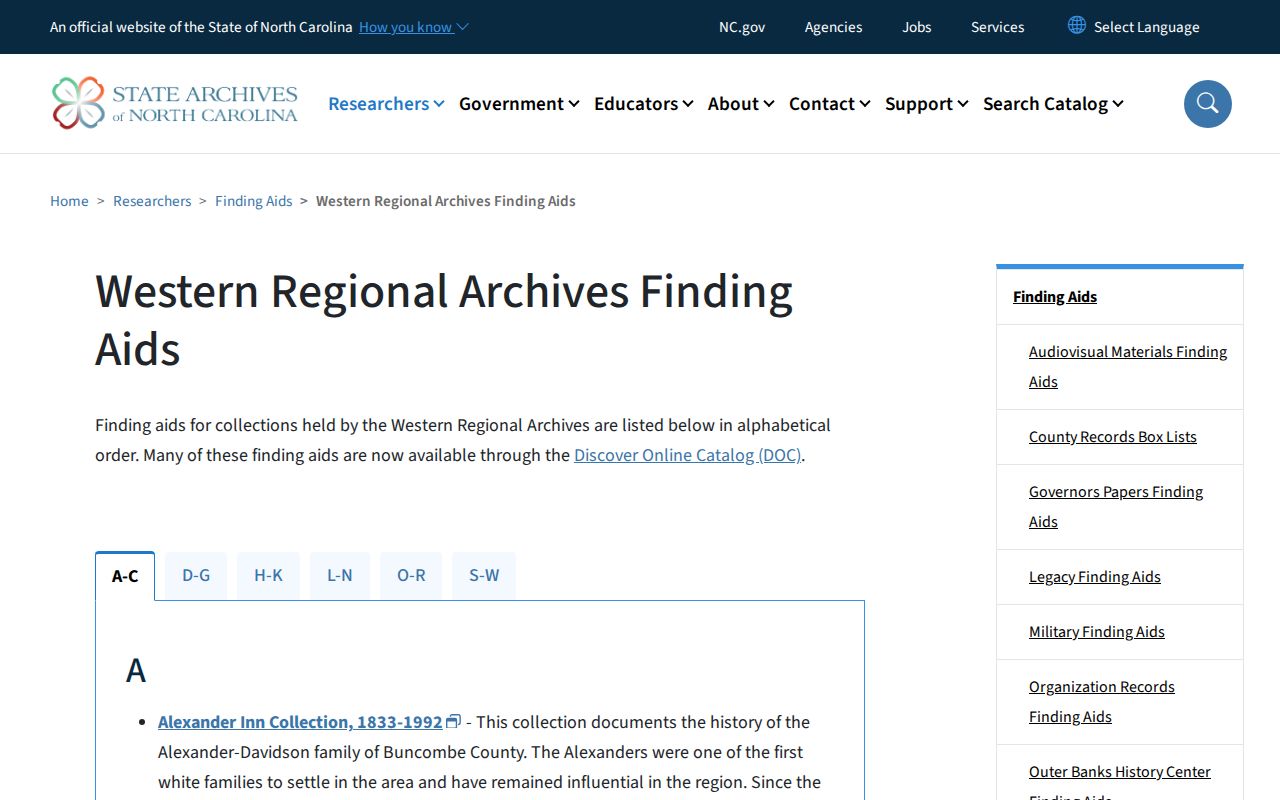
Repository finding aids help turn a directory name into a targeted request for family, business, guest-register, or community material.
Buncombe Historical Directory Limits
City directories are selective historical publications. They can omit rural residents, people without a stable listed address, and people who were not reached by a canvass. A listed address indicates an association in that edition, not every person in the household. A street listing is not a deed, and a deed is not proof of occupancy. Keep each source in its lane.
For an old address, use the relevant directory volume with maps, tax cards, and recorded deeds. For a person, compare names, initials, spouses, and dates across independently kept records. That careful sequence is especially important in Buncombe, where Asheville postal labels, shifting numbers, and directory coverage all vary by era.
Note: A directory year documents the publisher's listing for that edition, not a complete census, title opinion, or present-day resident list.