
Finding Buncombe Residents
Use an address to begin with Buncombe County Tax Lookup or Buncomap. Both can connect a situs address to a PIN and an owner name. Use a name to check the North Carolina voter profile, recorded deed index, court portal, and business records as separate clues. For a person from an earlier era, Pack Memorial Library's directory shelves and newspaper microfilm are often more useful than a current roll. None of these sources is a complete list of everyone at an address. A tax owner may live elsewhere, a registered voter may have moved, and a deed party may be acting for a trust or entity.
Keep the spelling, search date, county, and record type with each result. That makes it easier to separate a same-name match from the person sought and to return to a custodian when an older record is not online.
- Search a known address in Tax Lookup or Buncomap and save the PIN, situs address, owner name, and deed or plat references.
- For a named person, use the NC Voter Search with the county filter and compare the returned status and precinct with other evidence.
- Search the Register of Deeds Quick Name Search for grantors and grantees, then note the recording date and book or document reference.
- For an older household, consult Pack's Asheville directories and the digitized volumes at DigitalNC.
- When an existing record is absent online, make a focused request to the office that keeps it rather than asking staff to reconstruct a person history.
Buncombe Resident Records Desks
Buncombe's recorder, land-records staff, and elections office maintain different portions of the resident trail. The Register of Deeds preserves recorded instruments and vital-record channels. Land Records and Tax Collections connect current parcels, map layers, and tax data. Elections maintains registration and precinct information. Court files sit with the Clerk of Superior Court. Each office can confirm what its own records mean, but one office cannot merge the systems into a single personal profile. For a street-by-street property method, use the Buncombe street directory information.
Buncombe Register of Deeds
205 College Street
Asheville, NC 28801
828-250-4302, real estate
Buncombe Land Records
182 College Street
Asheville, NC 28801
828-250-4970, mapping
Buncombe Property Roll Searches
Buncombe County Tax Lookup accepts All Criteria, Owner Name, Address, Parcel ID, and Bill Number searches. It requires a search phrase of at least three characters and offers bill-status and bill-type filters, plus result export. An address result can show a PIN, situs address, owner name, amount due, a parcel link, and result pagination. The site cautions that the data is not certification that taxes are paid or due and may omit some not-yet-billed Discovery or Deferral bills. Land information is billed as of January 1.
Tax Lookup is a current property clue. A mailing address may differ from the physical situs address, and ownership is not proof that a person occupies the property. Open the parcel record and compare it with a recorded instrument before relying on it for an estate, family-history, or consumer-safety question.
| Tax Lookup field | How it helps | Limit |
|---|---|---|
| Owner Name | Finds a current tax-owner result. | Does not establish occupancy. |
| Address | Finds visible parcel results along a street. | Use the correct postal community and ZIP. |
| Parcel ID | Targets one county parcel. | It is not a deed-book reference. |
| Bill Number | Targets a known tax bill. | Bill status is not a legal certification. |
Note: Older assessor books and tax scrolls are routed through the County Record Archive, where each collection has its own coverage.
Buncombe Voter Record Checks
The statewide voter lookup requires first and last names and at least one voter status. Middle initial, year of birth, and county are optional ways to narrow a search. A returned profile can show registration status, party, jurisdictions, polling place, sample-ballot information, and voter history. It is a one-person profile, not a street roster. Buncombe County has 80 precincts, so a county and precinct comparison can be more useful than a name alone.
The official NC voter search is the right source for a registration question. Dates of birth, identification information, and email are confidential under North Carolina law. A protected voter may have a concealed address, and a current profile does not prove that every member of a household lives at that address.
View the official voter-search screen before trying the form. It shows why a middle initial, county selection, and status checkbox matter when Buncombe residents share a common name.
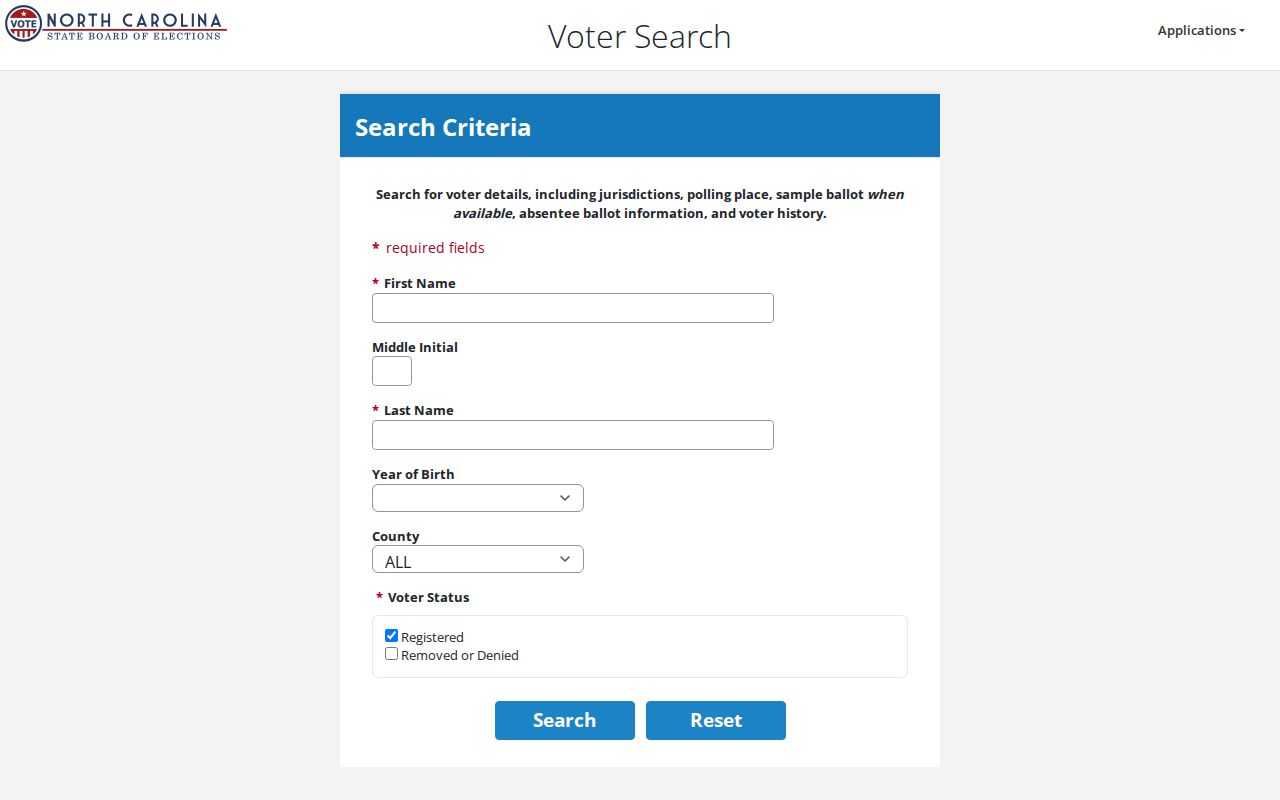
For a broader record request, G.S. 163-82.10 permits certain voter lists by written request, but it does not make confidential fields or protected addresses available.
Buncombe Deed Index Trails
The Register of Deeds Quick Name Search is name-centered. Start at an address in Tax Lookup or Buncomap, identify the current owner, then search that owner as a grantee. The deed identifies a grantor, recording date, legal description, and book, page, or document reference. Searching the grantor as an earlier grantee can extend the ownership trail. Keep the legal description and plat references with the search, because a historic street number can change while the parcel description remains useful.
The county's certified-date screen distinguishes record series. Its pre-1995 deeds, corporations, and assumed-name series begins October 13, 1783. Consolidated real property begins January 1, 1995, while the pre-1995 deeds-of-trust series begins August 21, 1928. A lack of a hit in one series is not proof that no earlier record exists. The Public Record Search Room at 205 College Street is open 8 a.m. to 5 p.m. for public records, and mail copy requests are an alternative.
- Parcel
- A county land unit identified by a PIN, used to connect tax and map records.
- Grantor
- The party transferring an interest in a recorded instrument.
- Grantee
- The party receiving that interest.
- Criss-cross directory
- An address-to-occupant directory format; Pack's verified street indexes can serve this purpose when a reverse-volume run is unknown.
Current Buncombe Resident Sources
No present-day Buncombe resident directory is a universal household list. Each official source answers a narrower question. The property roll is strongest for taxable parcels and owners. The voter profile confirms a registration record subject to privacy rules. The recorder identifies people or entities in instruments. Courts identify parties to permitted cases, while business and license systems identify public affiliations rather than a home address. Match the source to the question and record its date.
| Source | What it can confirm | Custodian | Access route |
|---|---|---|---|
| Tax Lookup | Owner, situs, PIN, and current tax result | Buncombe Tax Assessment | Public online search |
| NC Voter Search | Registration, precinct, and voter history | State Board of Elections | Individual profile or written list request |
| Deed index | Grantor, grantee, instrument, and date | Buncombe Register of Deeds | Online index, counter, or mail copy request |
| eCourts Portal | Permitted case-party and docket information | North Carolina Judicial Branch | Public portal or clerk terminal |
| Pack collections | Historic names, addresses, and local context | Pack Special Collections | Reading room and digitized collections |
A record found under a name should be checked against another source before it is treated as a match. The Buncombe resident lookup page focuses on that one-person verification work.
Buncombe Court Record Names
North Carolina eCourts Portal provides anonymous public Smart Search and Judgment Search access for permitted cases. Smart Search can begin with a name or case number and supports filters for location, case type, case status, and filing-date range. Official guidance describes case summaries, party information, causes of action, events, dispositions, hearings, and financial information when applicable. A case hit is a lead to a court file, not an identification of a particular person with that name.
Use the Clerk of Superior Court at 60 Court Plaza for a Buncombe file or public terminal when the portal does not resolve the question. The clerk's local certified criminal name inquiry requires full name and date of birth, costs $25, and covers Buncombe criminal charges only. It is not a fingerprint identity match. Sealed, juvenile, expunged, confidential, and some protected material does not appear in public access.
Buncombe Vital Record Routes
Buncombe Register of Deeds issues county-event birth, death, and marriage certificates. The county purchase portal lists a $10 certified certificate plus applicable card service fee, while the county form lists $0.25 uncertified copies. Certified copies require an eligible relationship or authority and a valid photo ID. The local index or certificate process is not an open search of every family fact. Adoption originals, medical birth information, and several parent or child data elements have distinct restrictions under G.S. 130A-93.
When the event is outside the county or a state route is needed, NC Vital Records accepts mail, authorized online or phone orders, and appointment-only in-person requests. The state first or search copy is $24, with the search fee nonrefundable if no record is found. For a divorce decree, contact the Clerk of Court where the case was filed. Before statewide registration began in October 1913, church records, family Bibles, newspapers, cemeteries, deeds, and probate can supply historical context.
Buncombe Records Need Corroboration
A property result is not a title search, proof of occupancy, or a survey. Buncomap is compiled from deeds, plats, and other public records, yet Buncombe County says the map is not survey grade and that primary documents should be consulted. The map refreshes at 6 a.m. on weekdays. Its layers are useful for checking whether an address issue is postal, municipal, parcel-based, or within a district, but the selected parcel still needs to be verified against the underlying deed or plat.
| Official source | Best use | What it cannot settle alone |
|---|---|---|
| Tax and GIS records | Current parcel and map context | Title, occupancy, or survey boundaries |
| Deed index and image | Recorded party and legal description | An unrecorded agreement or complete title opinion |
| Voter profile | Registration and precinct context | Every household member or protected address |
| Historic directory | Association with an address in a volume year | Continuous residence or legal ownership |
The commercial people-search category may combine stale or mismatched feeds. Custodian records, checked by date and record type, are the safer way to verify a Buncombe result.
Buncombe License Record Leads
A business or professional record can explain a public affiliation without identifying a home. The North Carolina Secretary of State Business Registration Search supports entity, assumed-name, and registered-agent searching. Buncombe's Register of Deeds index can add county assumed-name and UCC material. For a licensed occupation, North Carolina's professional-license directory routes searchers to the applicable board. Compare any result with the agency that regulates that record, because the statewide directory is an index rather than one universal license-status file.
Search business names with punctuation, suffix, and spelling variants. An officer, agent, practitioner, or contractor connection is not a residential-address claim. When an address is the real question, return to a parcel, deed, voter, or historical source that expressly records the relevant relationship.
The state license directory shows the board-based starting points available for a Buncombe affiliation search.

Use the linked board record to confirm current status instead of treating a broad category listing as proof of an individual's current role.
Buncombe Prior Address Clues
NC Cash provides a free name or business-name search for unclaimed property and updates its database daily. A result can be a lead to a former address or name variation, but it is not a resident roll and a claim requires proof. The amount shown may also be limited until the claimant supplies documentation. Search the official state database directly rather than responding to a message that asks for an advance fee or financial information.
For a Buncombe family-history question, an unclaimed-property lead can be compared with deeds, probate, newspaper notices, or city directories. It cannot establish that a person currently lives at an address.
The official NC Cash search is a direct state channel for this narrow kind of name connection.
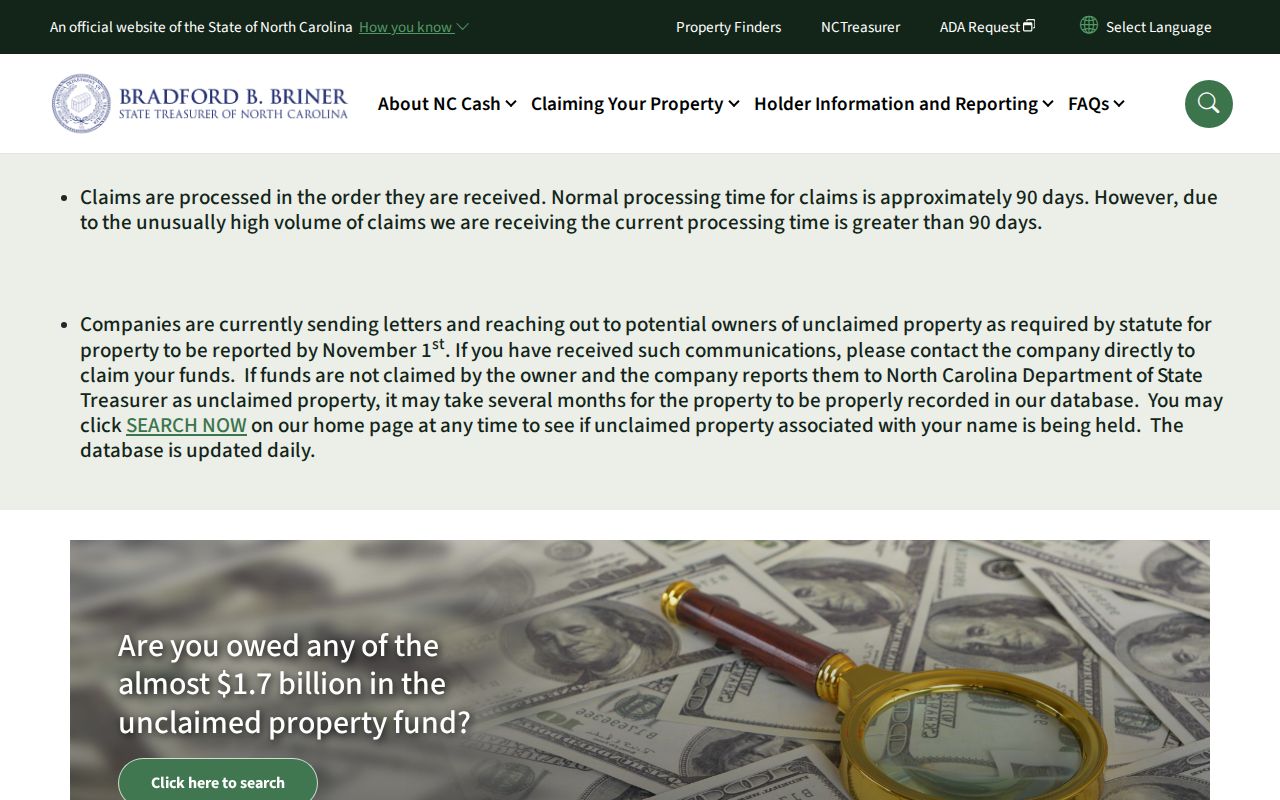
NC Cash advises users to use its own search and claim process, which helps avoid look-alike fee and phishing attempts.
Historic Buncombe Resident Directories
Asheville city directories are the core historic resident source for Buncombe County. Pack Special Collections describes its run as 1883 to the present, with name, street, and business listings in its lower-level collection at Pack Memorial Library. The 1883-84 Asheville City Directory and Gazetteer is identified as the first of its kind for Western North Carolina and also includes a county gazetteer. A directory entry may give a name, address, occupation, spouse notation, or business, but only for that edition's coverage.
DigitalNC offers selected scans, including 1883-84, Miller's volumes, and Hill's volumes. Its inspected result set returned 57 Buncombe and Asheville directory records, not a complete online run. The full collection, how to interpret an entry, and the historical street-index method are handled in the Buncombe city directory reference.
Buncombe Directory Collections
DigitalNC's 1883-84 directory scan preserves the earliest identified Asheville volume. Its introduction warns that some streets were unnamed and that exact residences could not always be assigned, especially outside the city core. That is a documented limitation of the volume, not evidence that a person was absent from the county. Search a surname, business, nearby entry, and post-office description together when a street number fails.
The 1937 Miller directory sample shows how a volume may contain surname and given name, spouse, occupation, employer, number, street, and abbreviations such as householder or roomer. Read each volume's own key because publishers used different abbreviations. Pack also holds local newspapers on microfiche, maps, photographs, oral histories, and house-history materials that can provide the context a printed directory leaves out.
Buncombe Address Number Gaps
Early Asheville house numbers changed as new houses were built, especially before 1930, according to Pack's house-history guide. The practical response is to search the street without an exact number, test neighboring numbers, and compare directories with deed legal descriptions, plats, Sanborn maps, and the 1891 or 1912 Asheville panoramic maps. A modern exact-number search can fail even when the older house and family are documented under a prior numbering pattern.
Pack's Special Collections began in Asheville City Hall and moved to Pack Memorial Library in 1943. The collection now preserves the directories, local histories, and visual records that help bridge an address change. For assisted local research, the Old Buncombe County Genealogical Society maintains a library of more than 10,000 volumes and offers free simple lookups, with small copy-assistance fees for mailed material.
Buncombe Record Request Limits
North Carolina Public Records Law, Chapter 132, permits inspection of existing public records at reasonable times and requires copies as promptly as possible. It does not require a county office to create, compile, analyze, or research a new record set. A useful request identifies the existing record, period, address or PIN, office, and desired copy. That approach is more likely to reach the proper custodian than a request to identify an unknown person from limited information.
The county public-records route and Asheville's request portal are alternatives when the named office does not publish a record online. Asheville specifically describes its route as a way to request existing city records; it does not hold county tax, real-estate, court, or vital records. Copy charges can be actual cost or a reasonable special-service charge when extensive labor or technology is needed.
See the statutory text in G.S. 132-6 before requesting an electronic record. It distinguishes access to existing information from a duty to make a new analysis.
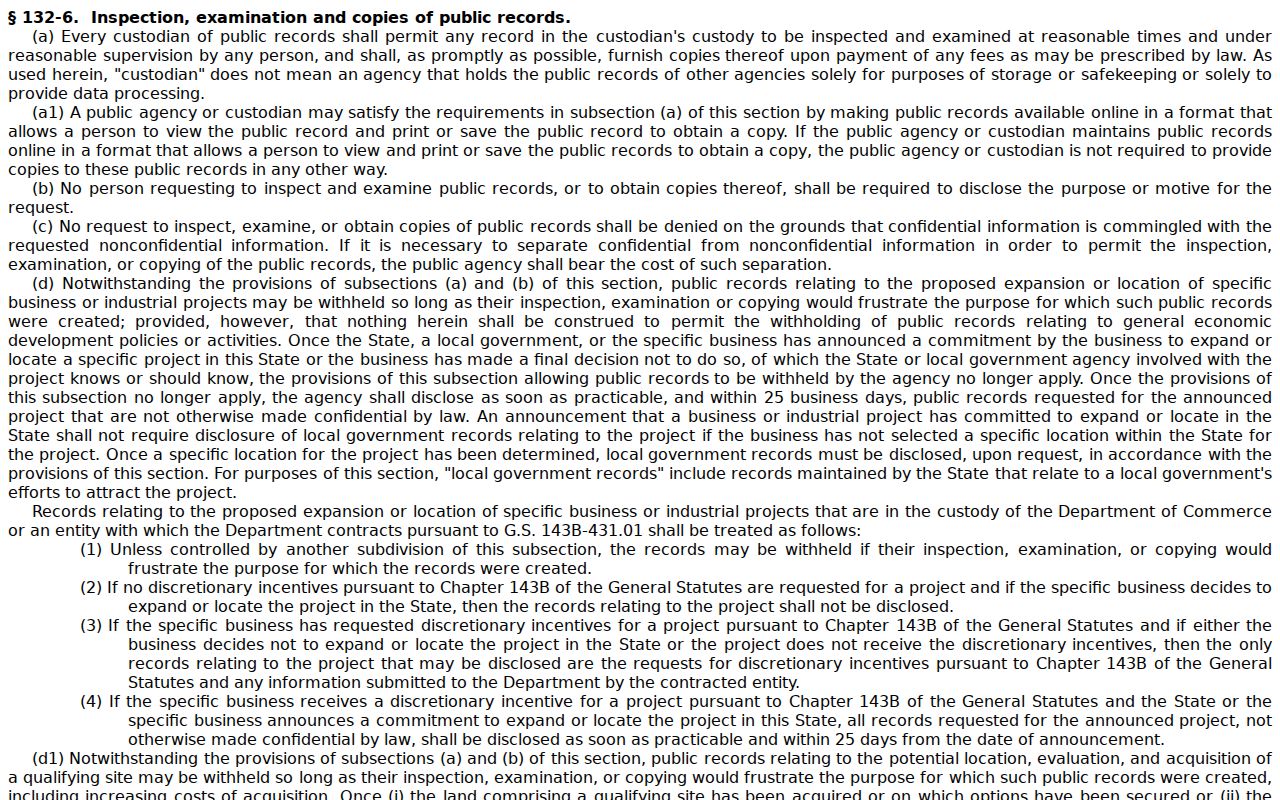
This official statute source is a useful starting point for the state access rule, but record-specific confidentiality laws still control protected information.
Buncombe GIS Records Update
Buncombe County announced updated GIS map tools on February 9, 2026, including post-Helene imagery, vector tiling, updated navigation, and KMZ export. The newer map presentation sits alongside Buncomap's documented search tools, such as PINN, street-name, and owner-name searches; deed or plat book-page mode; selectable layers; and multiple-feature or buffer tools. The tools can make a parcel trail easier to inspect, but they do not convert map data into survey evidence.
The county GIS update notice is the source for the current imagery and export changes. Use it with the county's online help when a Buncombe map interface changes, and confirm a critical parcel fact from the underlying public document.